Benimaclet
Start at Plaça de Benimaclet and the Iglesia de la Asunción, then visit the murals in Callejón de Sant Mateu. For food, try Verbena, an esmorzaret bar serving the traditional Valencian mid-morning meal; for horchata, head to Horchatería Rin. The recommendations below cover the square, bars and cultural spaces in the neighbourhood.
Getting to Benimaclet: metro lines 3 and 9 at Benimaclet station, or tram lines 4 and 6 at Vicent Zaragozà. EMT bus lines 12 and 70 serve the area around the square.
What to see in Benimaclet
Market
- BenimarketPlaça de Benimaclet
A self-managed artisan market that started in December 2016, driven by Javier Undiano (of Estudio 64) together with the neighborhood association. It began as a monthly event and now runs three times a year (May, October, December); the 25th edition, in December 2025, drew around 60 stalls.
Squares
- Plaça de BenimacletPlaça de Benimaclet, s/n
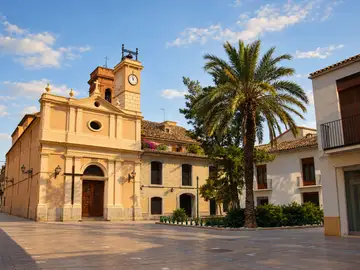
The square holds the Iglesia de la Asunción and, behind the fountain, the former town hall - seat of the independent town of Benimaclet before it was annexed to Valencia in 1878 and became a full city district around 1970-1972. The original crossroads of Calle Murta and Calle Barón de San Petrillo still organizes the neighborhood, and some 19th-century signage still reads 'Pueblo de Benimaclet.'
Bars
- VerbenaCarrer d'Utiel, 9
An esmorzaret bar (the traditional Valencian breakfast-lunch) opened by Hugo & Company because the neighborhood didn't have one; a large mural by artist Gisela Talita decorates the facade. It serves figatells, lleterola and grilled sardines, with a 7.50-euro lunch menu and a terrace on a pedestrian street.
Cafes
- Horchatería RinCalle Emilio Baró, 83
An artisanal horchata shop running since 1980, using chufas grown on the family's own fields in Alboraya.
Shops
- Ca'l BessóCamí de Farinós
A working farmhouse (alquería) in Benimaclet's remaining huerta, rebuilt in 1906 after a flood destroyed the original barracas; it ran as a farm shop-bar until about 72 years ago, selling rice, sugar and morcillas. It's now run by Llorenç Hurtado (about 73) and his brother, who farm roughly 50 hanegadas and sell potatoes, onions, chufas and artichokes directly to the neighborhood; his granddaughter Meritxell handles sales and the Facebook page.
- Estudio 64Carrer de Benicolet, 2 bajo
An illustration bookshop-gallery founded in 2014 next to the plaza; it closed and reopened in 2020 as a tribute after the death of its founder, Javier Undiano, the same person who had started Benimarket.
Street art
- Murales del Callejón de Sant MateuCallejón de Sant Mateu
This alley holds the densest concentration of work from 'Benimaclet conFusió,' the mural festival that repaints facades each edition; the pieces here are by J. Warx, a Benimaclet resident, and by Zarva Barroso.
Institutions
- Centre Instructiu Musical de Benimaclet (CIM)Carrer del Baró de San Petrillo, 14
A working-class music society formed in 1910-1911 when two earlier societies merged. More than a century later it still runs a music school and an old-school bar - beer, chess, pool - alongside concerts and exhibitions.
- Casal Social Okupat de l'Horta (CSOA)
An occupied farmhouse used as a self-managed social space since 2012. Spain's national police evicted it on 14 December 2020 (at the request of Sareb, under an order from Valencia's Instrucción Court No. 13); neighbors and collectives re-occupied it afterward. Then-mayor Joan Ribó (Compromís) publicly defended its social value.
📍 Places
History and life in the neighbourhood
Benimaclet was its own town until Valencia annexed it in 1878, and it didn't become a full city district until around 1970-1972 (sources split on the exact year). The old crossroads of Calle Murta and Calle Barón de San Petrillo still organizes the neighborhood, and in the square - next to the Iglesia de la Asunción - the former town hall sits behind the fountain. Some 19th-century signage still reads "Pueblo de Benimaclet."
That continuity shows up in daily life, not just in the street plan. On Camí de Farinos, a farmhouse rebuilt in 1906 after a flood destroyed the original barracas still sells potatoes, onions, chufas and artichokes from its own fields, now run by Llorenç Hurtado, about 73, and his brother. The Centre Instructiu Musical, a workers' society formed when two earlier groups merged in 1910-1911, is still a music school and neighborhood bar - beer, chess, pool - rather than a preserved relic.
The university nearby cuts both ways. It feeds a Valencian-language activist tradition: the Associació de Veïns i Veïnes de Benimaclet, founded in 1974 and legalized in 1976, is still a reference point, with roughly 30 cultural and social groups active in the barrio today. It also drives up rent. In September 2024 the association formally asked the city to declare Benimaclet a "zona tensionada" (rent-stressed zone), pointing to a resident who moved to Benetússer for 750 euros a month - what they used to pay in Benimaclet - against 1,200 euros now being asked in the neighborhood, and buildings with a recommended cap of 600 euros pulling 1,300-1,400 through room-by-room rentals to students. The pressure, per the association, comes from tourist apartments and month-to-month room rentals.
That tension has a specific political history too: a farmhouse occupied since 2012 as a self-managed social space was evicted by Spain's national police on 14 December 2020, then re-occupied by neighbors and collectives; then-mayor Joan Ribó publicly defended its social value.